How to Quit Cocaine: What I’m Trying Instead of “Never Again”
I called it “How to Quit Cocaine” because that may be exactly what you searched for. This is not a treatment plan. It is one simple thing I have been trying in my own life.
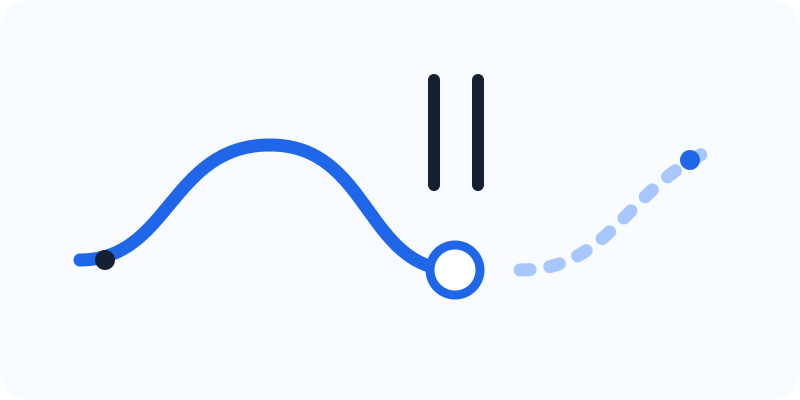
Why I called this “How to Quit Cocaine”
Because that is the question. Not “how do I become a perfect person?” Not “how do I promise the rest of my life?” Just: how do I stop doing this?
I do not have a magic answer. I am not a doctor, and Stop Dependencies is not cocaine treatment. What I do have is a small experiment that has been useful to me: when I want cocaine, I delay the next decision.
Sometimes I start with fifteen minutes.
Fifteen minutes is small enough to be real
“Never again” can feel enormous when cocaine is available and the mind is already making plans. Fifteen minutes is different. I can look at fifteen minutes. I can wait.
So I start the interval and make one rule for myself: while that timer is running, I do not take the next step toward cocaine.
When it ends, I can come back and choose again. Sometimes I choose another fifteen minutes. Sometimes thirty. Sometimes I eventually choose three hours or twelve hours.
The strange thing is that after repeating this enough times, I often get tired of waiting on the same short interval. I start doing something else. I read something. I look at a site. I think about tomorrow. The evening begins to contain other things again.
The important part is what actually happened
Forget the big claim for a moment. Forget whether this is “the method” or whether it deserves a name.
If I started a fifteen-minute interval and did not use cocaine during those fifteen minutes, then those fifteen minutes happened.
If I did it again, that happened too.
If I kept returning and two days passed, then I spent two days repeatedly choosing not to use cocaine during the intervals I set. That does not prove I have beaten an addiction. It does not guarantee what I will do tomorrow. But those two days are real.
For me, that matters more than making a dramatic promise and breaking it the same night.
What I notice when the craving starts building
Cocaine can turn an evening into a chain of “more.” More stimulation. More movement. More plans. More intensity. It can make an ordinary night suddenly feel as if it needs to become a bigger night.
I know that feeling. The mind starts offering possibilities and making the next step sound necessary. That is exactly the moment I am trying to interrupt.
The timer does not remove the craving. It gives me somewhere to put the next decision.
Eventually I begin caring about something else
There are nights when what helps me is very ordinary: I want to sleep properly. I want to train. I want to look better tomorrow. I want a clear face and clear eyes. I want to feel like myself when I wake up.
Sometimes another person can unexpectedly become part of that motivation. Not because I am changing my life for them, and not because they owe me anything. Just because wanting to see someone can remind me that I care how I show up in my own life.
That changes the question. Instead of only asking “Do I want cocaine right now?”, I can also ask “Do I want to give tomorrow away for this?”
This is a tool, not a promise of treatment
I want to be precise about this. A timer on a website is not a medical treatment for cocaine use disorder. Cocaine cravings can be intense, and established treatment can include talking therapies such as cognitive behavioural therapy and incentive-based approaches that reward continued abstinence. Professional support can be especially useful when stopping alone keeps turning into the same cycle.
What this tool can do is much smaller: create a pause before the next action. For me, that pause has been worth using.
Try it without believing in it
You do not have to tell yourself this will change your life. You do not even have to believe it will work.
When the next urge comes, choose an interval you can genuinely see yourself completing. During that interval, do not use cocaine. When it ends, return and choose again.
Then look at what happened instead of what you promised.
If you spent the day coming back to a button instead of going back to cocaine, that day happened.
Maybe tomorrow you do it again.