How to Stop Drinking and Using Drugs: Try the Next Interval
The interval method works when you follow its rule: choose a period, do not use during it, complete it, come back, and choose again. That is the result claimed here — real time completed without using, not a promise to cure addiction.
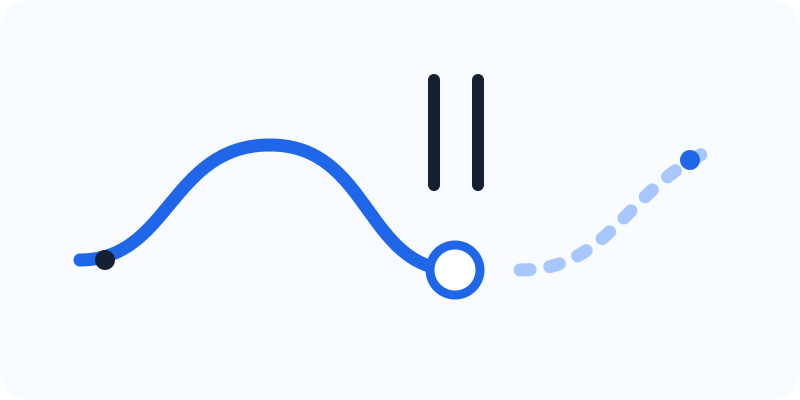
Yes, I call this a method that works
I am comfortable saying that because I am being precise about the result. I am not saying a timer cures addiction. I am saying the method works for the task it gives you: complete the interval without using.
If you follow that rule for fifteen minutes, you have fifteen minutes without using. If you follow it for twelve hours, you have twelve hours. If you return and do it again, you create another completed interval. The result is not theoretical. It is the time you actually completed.
The instruction is almost stupidly simple
Choose what you do not want to use right now. Choose an interval. While that interval is running, do not use it. When the interval ends, come back to Stop Dependencies and choose another interval.
Fifteen minutes. Thirty minutes. One hour. Three hours. Twelve hours. One day. Start with the period you can actually see yourself completing.
You do not need to promise “never again.” You do not need to announce anything. You do not need to join a group. You do not even need to believe that this will change your life. The only job is the interval in front of you.
The click is not the result
Coming back to the site is not about collecting check marks. The button matters because it gives the next decision a place to happen.
If you choose twelve hours and you do not drink or use the drug you selected during those twelve hours, then twelve hours without it happened. That is the completed action. If you come back and complete another interval, that happened too.
This is the part I can say confidently without pretending the website is a clinic: the method worked for that interval because the rule was completed. It does not prove that dependence is cured. It does not guarantee the next interval. But nobody can erase the time you already completed.
What I mean by getting into a different flow
I do not mean a movement, a membership or a community you have to belong to. There is nothing to join here.
I mean a repeated direction. An athlete returns to training because training has become part of what they do. In the same way, I can return here before I return to the old habit. The repetition itself begins to create another route through the day.
The old flow can be powerful: work, exhaustion, emptiness, the thought of a drink or a drug, then the search for a bigger emotional hit, then more. The next step can begin to feel automatic.
The interval gives me a different sequence: urge, pause, return, choose. Then do it again.
You can want it badly and still wait
This matters because cravings do not always arrive politely. Sometimes the pull toward alcohol or drugs can feel enormous. For me, stimulant use could turn an ordinary evening into a search for more intensity, more excitement and another emotional peak.
I am not claiming that everyone experiences drugs in exactly the same way. I am saying that when the pull is strong, demanding a lifetime decision from myself can be less useful than asking for the next fifteen minutes.
The interval does not have to destroy the craving. It only has to give me a rule I am willing to follow until the timer ends.
Then something ordinary can start to matter again
When I keep choosing the next interval, the evening has time to become something other than the old plan. I can think about sleep. Training tomorrow. My body. How I want to look and feel. The person I want to be when I wake up.
Sometimes sobriety makes old plans look strangely different. An adventure that seemed urgent while chasing stimulation can lose some of its importance after enough clear time has passed.
That is one reason I keep returning. Not to prove that I am fixed. To keep giving the other version of the evening a chance to exist.
Returning is part of the instruction
Do not treat the end of a successful interval as the moment to disappear. The return matters. Come back before the old automatic sequence takes over, choose the next interval, and put the rule in front of you again.
You are not checking in for us. There is no attendance list and nobody is waiting for your mark. You return for yourself, because returning keeps you in the sequence you chose: pause, complete, return, choose again.
Use the tool, not a promise
Open Stop Dependencies. Choose the substance or habit. Choose an interval you can genuinely complete. While it is running, follow the rule you chose. When it ends, come back before you go back to the habit. Choose again.
If you slip later, the earlier intervals were still real. Start from the next decision rather than pretending the time you already completed disappeared.
For me, that is the method. It is deliberately small because the thing I am trying to interrupt can be very powerful.
What this does — and what it does not claim
Stop Dependencies is a behavioral tool, not a treatment service. Substance use disorders are treatable health conditions, and established care can include behavioral therapies, medications for some substance use disorders, and professional support. This site does not replace those options.
The claim is specific: when you follow the interval rule and do not use during that interval, the method has produced the result it asks you to produce — that completed time without using. It does not promise permanent abstinence, treatment of dependence, or success on every future interval. Those are different claims.